TERRELL THEEN
PORTFOLIO
THEMATIC DESIGN VISUAL STORYTELLING ARTISTIC PROCESS

The Art of Themed Design
Themed Design extends far beyond the composition of space, function, color, and texture. At its best, it becomes a multidisciplinary art form that transcends time, geography, and mood.
By weaving together 3D artistry, experiential storytelling, environmental graphics, lighting design, visual language, and intuitive wayfinding, interior designers craft spaces that immerse guests, evoke emotion, and leave a lasting impression.
This page presents a glimpse into that creative journey, showcasing the process from initial inspiration to the realization of a richly themed, story-driven environment.
Case Study #1: Theatre of the Mind
I will use my story-driven, themed illustrations to showcase the creative process starting with a narrative, which leads to inspiration, and then conceptual design studies, before resulting in a successful themed environment. The same process can be used for illustration, art, virtual environments, and themed interior design.
The Story: French Architect, Eugene-Emmanuel Viollet-le-Duc
This project highlights the theme of perseverance. Specifically, the clash between personal creative vision and public criticism.
Eugène Viollet-le-Duc, a 19th-century French architect, did not come from the elite schools of Paris. Instead, he rose from apprentice to master, becoming renowned for his influential work in the Gothic Revival movement. Trusted with restoring major landmarks such as Notre-Dame and Sainte-Chapelle, he approached restoration as a creative reimagining, aiming to return buildings to an idealized “perfect” state. His additions and reinterpretations, informed by deep study of medieval architecture, often sparked controversy.
Yet despite ongoing criticism, Viollet-le-Duc remained committed to his vision. Today, his bold restorations have become inseparable from our modern understanding of Gothic architecture, leaving a lasting imprint on France’s cultural heritage.

Eugene-Emmanuel Viollet-le-Duc
The Style: Romanticism

After considering a number of historic styles for this design, I ultimately chose the Romanticism Movement for a few reasons. First, I felt that its spatially large scenes, heavy atmospheric feel, and dramatic lighting effects would lend itself well to the telling of this story.
Furthermore, the Romantic Period overlapped Viollet-le-Duc's career, and was heavily influenced by the political and economic atmosphere of the French Revolution. So I felt that it was a style that reflected the timeliness of this story as well.

The Mood Board and Visual References:
A mood board is the emotional blueprint of a design. It’s a collage of imagery, textures, colors, and inspiration that paints the story of what the final space or artwork will feel like. It sets the tone long before the first line is drawn or material is chosen.


My first goal is to learn as much as possible about the central figure, Eugène Viollet-le-Duc. I want to understand his upbringing, education, profession, personal viewpoints, life challenges, and struggles, among other defining aspects of his story.
In this experience, I want the audience, or guest, to connect with him on an emotional level and discover a meaningful moment of inspiration drawn from his life and legacy.
Additional Research:
In addition to researching the main subject, costuming, lighting, and artistic style, the architecture will also require significant study to ensure that anything represented within the scene is accurate to the appropriate time period, location, building type, and symbolic meaning.


I use a wide range of research methods, but my personal favorite source is books. I own many excellent books on architecture and have checked out many more from the library. Online resources are valuable, of course, and I do a great deal of research online, but books often provide a concentrated collection of well-compiled, accurate information that can be difficult to find elsewhere.
Here are a few images from one of the books I studied extensively in an effort to become a “near” expert in Gothic architecture.

Initial Sketches & Ideation:
Typically, as I am conducting research, I also begin developing ideas through pencil sketches on paper. I do not usually show these early sketches to others because, in their unfinished state, they may not fully communicate the intent. Here, you can see a few of my initial studies, where I explored the Gothic architectural forms found throughout much of Viollet-le-Duc’s work. The purpose of these sketches was to experiment with how to tell the story through architectural details, symbolism, massing, composition, lighting, contrast, and the artistic style I intended to use.


As the vision begins to take shape, quick sketches are used to begin defining the shapes, patterns, masses, composition, balance, symbols, and more. Many of these sketches will be created as some ideas are eliminated and new ideas come to mind. Often times notes will be written to communicate the reasoning behind decisions.
In the case of Theatre of the Mind, the entire environment was sketched from various perspectives to fully understand how the story, and space would be perceived by the user, since this would ultimately be a fully 3D immersive experience, and not just a 2 dimensional image.
Digital, Hand-Painted Concept with Basic Lighting and Color Scheme:

Once a concept design has begun to take shape, a small, digitally hand-painted scene was created to help visualize color, atmosphere, balance, tone, story and mood. The contrast between foreground elements and background allowed for interesting Gestalt Perception opportunities.
3D Modeling and Building: Scene Development, Staging & Set Design
When the design is fully flushed out, and its ready to be blocked in, 3D models can be built to ensure proper scale, proportions, perspective, and lighting. This is the digital version of set design, staging and light focusing.


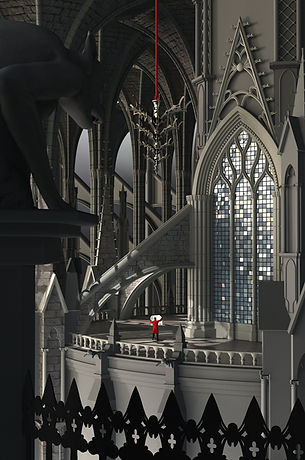

Theatre of the Mind: Key Art

Case Study #2: A New Journey

This themed illustration is titled A New Journey to reflect the paths both characters are about to take. The seasoned, accomplished knight sets out once more into the depths of the beautiful landscape of Southern Germany, while the young boy begins his own journey, stepping into his future as a skilled bladesmith.
The Backstory: German Knight, Gottfried von Berlichingen zu Hornberg
Gottfried “Götz” von Berlichingen zu Hornberg (1480–1562) remains one of the most memorable figures of early modern German history. A lesser noble from Württemberg, he built his reputation through fearless service as a knight, earning both admiration and infamy in the shifting political landscape of the Holy Roman Empire.
His legend was sealed in 1504, when he lost his right hand to cannon fire and refused to let the injury end his career. Instead, Götz commissioned an innovative mechanical iron prosthetic, which was ingeniously crafted with articulated fingers and locking mechanisms, that allowed him to hold weapons and reins. This “Iron Hand” became a hallmark of his identity and a symbol of extraordinary resilience.
Even as the age of traditional knighthood faded, Götz’s determination and defiant spirit ensured his place in history as a warrior who bridged the medieval world and the emerging modern era.

Gottfried von Berlichingen zu Hornberg
The Main Story: The Child Bladesmith, True Craftmanship
A young boy, armed with little more than determination and a few humble materials, gave everything he had to forge a sword for the knight departing the Kingdom. In the purity of the child’s gift lies the highest form of selflessness and an instinct to lift others up long before thinking of oneself.
When the moment came to present the finely crafted blade, no crowd gathered, no audience applauded. Only his younger brother and mother stood behind him, the quiet witness to an act that needed no recognition.
In that simple exchange lives a lesson: the grace of humility, the worth of ordinary people, the discovery of one’s own abilities, and the quiet strength of remaining true to oneself, content without fame, fortune, or the need to be seen.

The Mood Board and Visual References:
For the mood board, I wanted to find imagery of the German landscape, and the colors of the time, hair-styles, vocations, clothing, materials, architecture, infrastructure, plants, animals, symbols and details.

Initial Sketches - Medieval German Homes,Villages and Castles:
As an exercise in understanding construction techniques, architectural features, and comparative styles, I drew many simple drawings that depict a variety of features found in castles and other buildings of the same time period of this story. Below are a few of these simple drawings, often times 2 dimensional, or isometric drawings showing scale, and dimensions.


Initial Concept Sketches - Understanding the Environment:
In the following sketches, I explore a variety of ideas for what the scene could become, considering architecture, landscape, composition, balance, lighting, and story. These drawings are sometimes necessary to visualize how all of these elements might work together, while also helping me understand why certain ideas may not be successful. In some cases, these studies can even inspire an entirely new concept that can be saved and explored at another time.


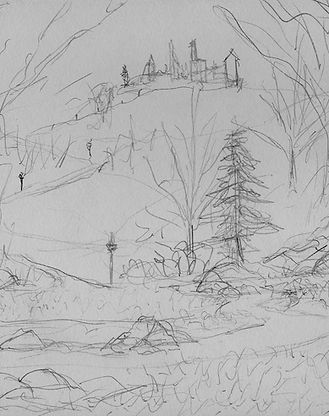


Initial Concept Sketches Exploring Color, Lighting, Balance, Composition and Story:
I knew I wanted to start with a hole in the clouds acting as the main spotlight on the characters with a slight backlight angle. That perspective defined the feeling of a greater power shining its light on a moment that deserved exposure. From there, I experimented with a variety of sketches for the rest of the scene. Unlike my last set of pencil sketches, I decided to sketch these concepts in digital form using a tablet which gave me an incredible amount of freedom to explore.


A New Journey: Key Art

Case Study #3: Opera at the Majestic
Inspired by Gaston Leroux’s 1909 novel The Phantom of the Opera and my longstanding love for Andrew Lloyd Webber’s celebrated Broadway musical, I created an illustration that blends two legendary worlds. It unites the exotic architecture and opulent interior design of the Palais Garnier in Paris, home of the world-renowned Phantom, with the historic Majestic Theatre in New York City, the beloved home of the musical that brought the Phantom’s story to life for generations.
The Story: The Phantom of the Opera
The Phantom of the Opera is a gothic romance about a disfigured musical genius who lives in the catacombs of the Palais Garnier, where he tutors a young ballerina, Christine Daae, to become a soprano vocalist when she wishes to be helped by the Angel of Music after her fathers passing. The Phantom pretends to be this Angel of Music to guide and mentor her, but becomes captivated and obsessed with her voice.
The Phantom then becomes increasingly jealous when she falls in love with her childhood friend, Raoul. This jealousy leads to terrifying and violent events orchestrated by the Phantom to get Christine to be with him instead of Raoul.

Gaston Leroux
The Mood Board and Visual References:
Because this scene would incorporate two different buildings, a stage, actresses, orchestra, set design, and other theatrical elements, I needed to create mood boards and references for a broader spectrum of information.
This board explores the architecture, interiors, lighting and artistic style.


This board focuses on formal dresses of the time period and location for costuming, as well as examples of how to incorporate the orchestra into the scene.
Additionally, a great deal of research had to be done to understand the ballet. It would be critical to have the correct poses, posture, arrangement and costumes for the ballerinas. The last thing you want is an expert in that area point out all of the things you did wrong. You only have one shot at getting it all correct, so do your research!

Initial Concept Sketches:
The combination of the original building being used as the set within the theatre created some unique challenges in the story telling. Using props, costumes, architectural elements, and the character poses would help me lead the viewers eye through the scene, and at the same time, create opportunities to include interesting architectural details.


3D Modeling and Building: Scene Development, Staging & Set Design
Once the concept sketch is cleaned up and detailed, I was able to start building the scene in 3D, and layering in all of the assets, props and making adjustments to sizes, depths, and overlap as needed.

Opera at the Majestic: Key Art

Case Study #4: The Ball in Baroque
Occasionally, the story can evolve from the environment. I find Baroque architecture to have fascinating features that create pools of interest, connected with free-flowing elements and great details, ornamentation, theatrics, and powerful emotion. Essentially, the Baroque style is so interesting that it forms the story in itself. In this case, I decided to start drawing an interior scene based on the Baroque style, and as I designed the space, I also found interesting opportunities for the use of the space, and began developing a fictional story within it. This particular piece is a work in progress, but I felt it was important to include due to the nature of the environment forming the narrative.
The Mood Board and Visual References:
My first mood board for this focused on the style and movement of the architecture itself, since the architecture was really the main story-line for this environment.

Initial Concept Sketches:
Since the architecture and interior design was the story, I started with traditional drawings including a loose floor plan, elevation drawings, details, handrails, statues and more. Then forming the perspective view and illustrating how the architectural features would be used to create direction, flow, weight, balance, overlap, sightlines and movement.


3D Modeling and Building: Scene Development, Staging & Set Design
Here, showing a work-in-progress, you see the blocking-in of the architectural elements, interior space, statues, lighting, and beginning to stage characters for scale, story, and interest. This shows the current stage of completion for The Ball in Baroque. The challenge is staying true to the sketch, while working in real perspective, proper scale and 3D constraints.
